All published articles of this journal are available on ScienceDirect.

Emerging Biomarkers in Heart Failure: Pathophysiological Mechanisms, Clinical Utility, and Multi-Omics-Driven Risk Stratification

Abstract
Heart failure is a complex clinical syndrome involving neurohormonal activation, myocardial injury, inflammation, fibrosis, metabolic dysregulation, and cardiorenal dysfunction. Natriuretic peptides and cardiac troponins are established biomarkers for diagnosis and risk assessment, but they do not fully capture the biological heterogeneity and progression of heart failure.
This narrative review examined emerging biomarkers through targeted searches of PubMed, Scopus, and Web of Science for literature published between January 2010 and January 2026, with earlier landmark studies included when relevant. The review focused on biomarkers, multi-omics approaches, precision cardiology, and machine learning in heart failure, emphasizing pathophysiological mechanisms, clinical utility, and translational potential.
Emerging biomarkers include growth differentiation factor-15, soluble neprilysin, adrenomedullin, microRNAs, and extracellular vesicle-derived biomarkers. Genomics, transcriptomics, proteomics, metabolomics, and epigenomics further provide opportunities for systems-level molecular characterization. Pathophysiological processes such as inflammation, oxidative stress, extracellular matrix remodelling, endothelial dysfunction, and metabolic perturbations may be captured through multidimensional biomarker strategies. Integration of high-dimensional molecular and clinical data with machine learning may improve phenotyping and risk assessment in selected populations.
Despite these advances, most emerging approaches remain investigational because of challenges involving standardization, reproducibility, external validation, clinical utility, cost-effectiveness, and ethical considerations. Multidimensional biomarker profiling may support precision cardiology, but prospective validation and implementation research are required before routine clinical adoption.
1. INTRODUCTION
Heart Failure (HF) continues to be a major global challenge in cardiovascular health, with recent estimates showing that over 64 million people worldwide are living with HF. The prevalence of HF continues to increase with the aging of populations, and survival rates after myocardial infarction improve. The incidence and prevalence of this condition have been further exacerbated by cardiometabolic risk factors such as high blood pressure and obesity [1]. HF continues to be strongly associated with morbidity and mortality despite advancements in pharmacological and device-based therapies. Notably, survival rates seen in HF may be comparable with those reported for multiple common malignancies [2].
HF cases are typically reported to have hospital readmissions, which are a burdensome driver of healthcare costs. Significant burdens are placed on healthcare systems through frequent episodes of decompensation, which makes HF one of the most financially demanding chronic cardiovascular diseases [3].
South Asian countries like India are shown to be severely impacted, particularly in Low- and Middle-Income Countries (LMICs). Considerable etiological variety is exhibited in these areas, with patients generally presenting with HF at younger ages. The healthcare system and economic conditions can lead to variability in access to recommended therapies. The prevalence of HF is expected to rise in these areas as several countries shift their transitional focus towards non-communicable diseases [4].
Different types of HF are presented clinically, such as heart failure with reduced ejection fraction (HFrEF), mildly reduced ejection fraction (HFmrEF), and preserved ejection fraction (HFpEF). Underlying biological mechanisms and response to treatments are distinguished in these types of ejection, though they share similar clinical features [5, 6].
Biomarkers can be crucial to HF management in contemporary times, with categories of biomarkers such as natriuretic peptides, including B-type natriuretic peptide and N-terminal pro-B-type natriuretic peptide (NT-proBNP). Diagnosis and assessment of risk are generally done through these biomarkers in clinical practice [7]. Ongoing myocardial injury may be assessed prognostically with additional information provided by cardiac troponins. Soluble ST2 (sST2) and galectin-3 have been investigated and show potential prognostic value in several observational studies and selected clinical trials, particularly being associated with myocardial stress and fibrosis. Although some biomarkers are available for use in clinical settings, limited data on their cost-effectiveness and use in routine therapeutic decisions remain inconsistent [8].
HF pathology generally has broader aspects; therefore, traditional biomarkers are limited by only demonstrating specific aspects of it. Specific aspects such as myocardial wall stress and cellular injury are indicated primarily by natriuretic peptides and troponins, respectively. Complex networks of biological processes such as inflammation, oxidative stress, extracellular matrix remodelling, endothelial dysfunction, metabolic disturbances, and cardiorenal interactions, combined or individually, lead to HF. Reliance on single biomarkers, therefore, may only provide a partial representation of the underlying disease pathology due to the complexity of HF. Biomarker levels may be predisposed through risk factors such as age, obesity, renal dysfunction, and systemic comorbidities, which may further complicate their clinical interpretation [9].
Integrative biomarker strategies have begun to gain prominence, with limitations imposed by single-biomarker use. HF is now viewed as a spectrum of biologically distinct syndromes, rather than treating it as a single condition. Therefore, multiple types of biological data, including genomics, transcriptomics, proteomics, metabolomics, and epigenomics, are used in precision medicine to address this heterogeneity [10].
Comprehensive interrogation of disease pathways at the systems level is enabled through advancements in multi-omics. The combination of clinical parameters and imaging results may provide insights to identify specific molecular signatures associated with particular types of HF. Preliminary studies suggest that these strategies may enhance risk prediction and phenotypic classification. However, many biomarkers remain in their exploratory phase and need external validation [11, 12].
In this review, the combination of different biological domains, such as proteomics, genomics, metabolomics, and transcriptomics, with clinical variables and advanced computational analysis is referred to as multidimensional biomarker profiling. The emphasis on integrating data across platforms and on systems-level interpretation separates this approach from standard multi-marker panels.
New biomarkers from multi-omics technologies may create valuable connections between molecular insights and therapeutic decisions as HF management slowly shifts towards personalized and mechanistic strategies. Stringent evaluation of analytical validity, reproducibility, clinical usefulness, and cost-effectiveness will, however, be essential before their routine implementation in clinical practice [13].
1.1. Literature Search Strategy
This narrative review was conducted using a structured literature search to ensure a comprehensive and balanced overview of emerging biomarkers in heart failure. Literature searches were conducted in PubMed, Scopus, and Web of Science for studies published between January 2010 and January 2026. Earlier landmark studies were included when considered essential for historical context or guideline development.
Search terms included combinations of “heart failure”, “biomarkers”, “BNP”, “NT-proBNP”, “GDF-15”, “galectin-3”, “ST2”, “microRNA”, “extracellular vesicles”, “proteomics”, “genomics”, “transcriptomics”, “metabolomics”, “epigenomics”, “multi-omics”, “artificial intelligence”, “machine learning”, “precision cardiology”, and “risk stratification” using Boolean operators (AND/OR).
Studies were selected based on their relevance to the pathophysiological mechanisms, clinical utility, and translational applications of biomarkers in heart failure. Eligible publications included English-language human studies, systematic reviews, meta-analyses, randomized and non-randomized clinical trials, observational studies, and major international guideline documents.
Conference abstracts, editorials, duplicate publications, and animal-only studies (unless providing essential mechanistic insights) were excluded.
2. PATHOPHYSIOLOGICAL BASIS OF BIOMARKER DEVELOPMENT
Neurohormonal activation, myocardial injury, inflammation, fibrosis, metabolic dysregulation, and cardiorenal cross-talk are dynamic interactions that are characterized in HF as a complex, multisystem syndrome. These mechanisms interact with each other and evolve during disease progression rather than functioning independently. These pathways' relative contributions may differ across various phenotypes, which adds to the clinical heterogeneity observed in patients. Due to this complexity, several biological domains are examined, gaining multiple signals rather than focusing on a single domain pathway. Although the understanding of pathological mechanisms has improved significantly due to advancements in molecular and translational research, it is challenging to translate mechanistic insights into biomarkers that are consistently useful in clinical practice.
The evidence supporting different biomarkers varies in reliability, and clear clinical applicability has not been consistently demonstrated for all biomarkers [14]. (Fig. 1) demonstrates the multidimensional interactions of these pathways.
2.1. Neurohormonal Activation
Dysregulation of neurological hormones is particularly relevant to HF progression. Compensatory systems such as the Renin Angiotensin Aldosterone System (RAAS) and the Sympathetic Nervous System (SNS) are activated in response to reduced cardiac output. Stability of circulation is aided through these systems; however, persistent activation of these systems contributes to harmful physiological changes, including vasoconstriction, sodium and water retention, myocardial hypertrophy, and progressive ventricular remodeling. Natriuretic peptides, specifically BNP and NT-proBNP, are widely used biomarkers to express these processes. Increased myocardial wall stress subsequently leads to the release of these biomarkers. Natriuretic peptides are firmly established as biomarkers in clinical practice for both diagnosis and prognostic assessment of HF [15].
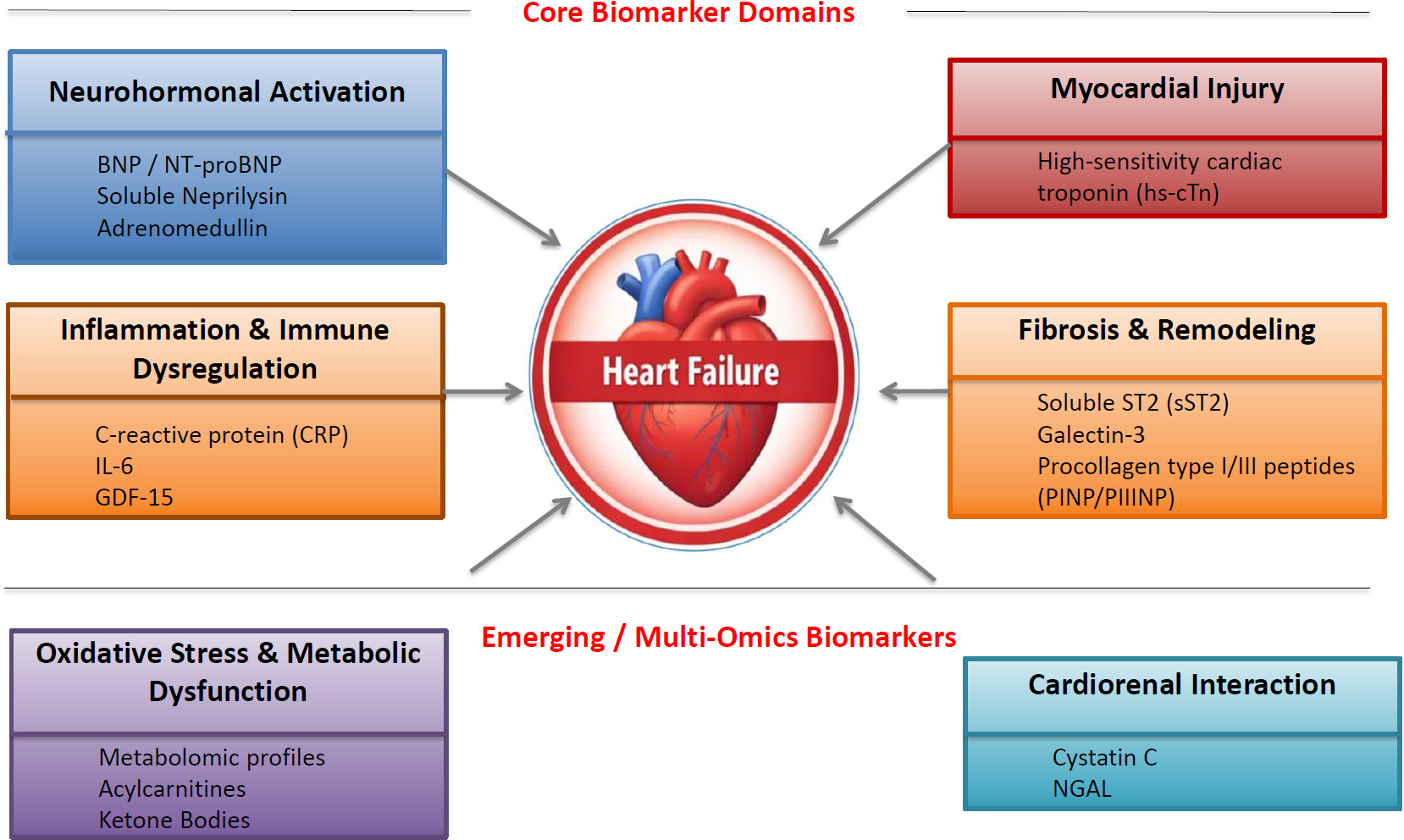
Major Pathophysiological pathways and biomarker domains in heart failure.
Abbreviations: BNP, B-type natriuretic peptide; NT-proBNP, N-terminal pro–B-type natriuretic peptide; hs-cTn, high-sensitivity cardiac troponin; CRP, C-reactive protein; IL-6, interleukin-6; GDF-15, growth differentiation factor-15; sST2, soluble suppression of tumorigenicity-2; PINP, procollagen type I N-terminal propeptide; PIIINP, procollagen type III N-terminal propeptide; NGAL, neutrophil gelatinase-associated lipocalin.
Although they are clinically useful, they primarily reflect hemodynamic stress and do not completely describe the biological processes involved in the progression of HF. Additionally, other factors may affect their interpretation, including age, obesity, atrial fibrillation, and renal dysfunction. Due to these limitations, other biomarkers related to neurohormonal activation have been proposed as potential biomarkers in HF. Soluble neprilysin and adrenomedullin may be explored as potential biomarkers due to their association with neurohormonal activation. Some observational studies have demonstrated their prognostic value in HF; however, no strong interventional evidence supports their use in routine practice due to considerable variations in assay methods across studies [16].
2.2. Myocardial Injury and Remodeling
The development and progression of HF is caused by important mechanisms such as persistent cardiomyocyte injury and structural remodeling of the heart. Low-grade myocardial damage may persist in patients with chronic HF even in the absence of acute coronary events. Poor outcomes in various phenotypes of HF have been shown with consistent measurements of high-sensitivity cardiac troponin assays for the detection of low-grade myocardial injury. Cardiac troponins measure evidence of direct cardiomyocyte injury in contrast to natriuretic peptides, which primarily reflect myocardial wall stress [17].
Mechanical stress and neurohormonal activation lead to structural remodeling of the myocardium, including increased collagen deposition and fibrotic changes that may structurally alter the myocardium, leading to dysfunction.
Soluble ST2 (sST2) is a member of the interleukin-1 receptor family used for measuring evidence of myocardial stretch and activation of inflammatory-fibrotic pathways. Galectin-3, linked to myocardial fibrosis, is involved in macrophage activation and collagen metabolism.
Multiple cohorts have demonstrated their independent prognostic value; however, the majority of the data have been derived from observational studies. Both of their incremental value over natriuretic peptides in the management of HF is continually disputed. Despite their availability, they are not universally included within algorithmic guidelines [18].
2.3. Inflammation and Immune Dysregulation
The pathogenesis of HF is significantly contributed to by chronic low-grade inflammation, especially in HFpEF. Endothelial dysfunction and myocardial remodeling, which may impair cardiac function over time, have been associated with inflammatory signaling pathways. Inflammatory mediators such as Interleukin-6 (IL-6), Tumor Necrosis Factor-α (TNF-α), and C-Reactive Protein (CRP) are elevated in patients with HF, often leading to poorer clinical outcomes. The clinical utility of these inflammatory markers, however, remains limited due to poor disease specificity. Various comorbid conditions are present in patients with HF, such as obesity and diabetes, leading to elevated levels of these inflammatory mediators. The interpretation of these biomarkers in isolation may prove to be difficult in clinical settings [19].
Growth Differentiation Factor-15 (GDF-15) is promising as a biomarker for reflecting systemic stress responses. GDF-15 is a cytokine that is elevated in inflammation, oxidative stress, and cellular injury. In patients with HF, elevated levels of GDF-15 are associated with increased disease severity and mortality risk in some clinical cohorts. Limitations such as variability in assays and measurement techniques may lead to changes in levels, and evidence supporting its use in therapeutic strategies for improvement of clinical outcomes is still limited. Although GDF-15 shows promise as a prognostic biomarker, further studies are needed to confirm its use in routine patient management [20].
2.4. Oxidative Stress and Metabolic Dysregulation
In HF, disturbances like impaired contractility and progressive myocardial dysfunction have been known to be associated with oxidative stress and mitochondrial dysfunction. Inflexibility in metabolism, reduced fatty acid metabolism, and changes in substrate utilization are frequently observed in later stages of the disease. Metabolomics has reported significant changes that may be used for determining disease severity, including changes in amino acids, lipids, and ketone bodies.
Despite valuable insights into the mechanistic aspects of the disease and its potential use in distinguishing HF phenotypes provided by these metabolomics studies, limitations remain. The reproducibility of results using different analytical techniques and different platforms still poses a major challenge. Generally, metabolomics studies have reported that these biomarkers are exploratory in nature and require further validation on a larger scale for routine clinical practice [21].
2.5. Fibrosis and Extracellular Matrix Turnover
Fibrotic signaling pathways are reflected by galectin-3 and sST2 [22]. Ventricular stiffening, diastolic dysfunction, and the development of arrhythmogenic substrates are significantly associated with myocardial fibrosis. Collagen synthesis and degradation in the myocardium are associated with biomarkers such as procollagen peptides and matrix metalloproteinases. Galectin-3 and sST2 are other biomarkers that also indicate fibrotic signaling pathways [22].
Inconsistency is generally observed in the degree of histologic fibrosis associated with circulating levels of fibrotic biomarkers. Diffuse interstitial fibrosis is generally observed in the myocardium in patients with HFpEF. Circulating levels of fibrotic biomarkers may, therefore, be mechanistically relevant. However, therapeutic implications of these biomarkers remain unclear [23].
2.6. Cardiorenal Dysfunction
Interpreting HF biomarkers is further complicated by cardiorenal interactions. In addition to being associated with the progression of HF, renal dysfunction may influence the clearance and circulating levels of various biomarkers, such as natriuretic peptides. Various biomarkers, such as cystatin C and Neutrophil Gelatinase-Associated Lipocalin (NGAL), have been further studied as indicators of renal injury and utility in risk stratification of patients with HF.
Despite valuable prognostic information in HF patients with coexisting renal dysfunction, their utility is limited by the confounding effects of kidney disease and the absence of standardized cut-off levels [24].
3. CLINICALLY ESTABLISHED BIOMARKERS: CURRENT STANDARD OF CARE
Circulating biomarkers play a central role in the diagnosis and risk stratification of heart failure in contemporary clinical practice. Among them, natriuretic peptides and cardiac troponins are well-established, supported by extensive prospective studies, and incorporated into international clinical guidelines. Other biomarkers, such as soluble ST2 and galectin-3, are also available and provide useful prognostic information, although they are not consistently included in routine therapeutic algorithms. Therefore, distinguishing between guideline-endorsed biomarkers and adjunctive markers is important to avoid overstating their current clinical applicability [25, 26].
3.1. Natriuretic Peptides
B-type Natriuretic Peptide (BNP) and N-terminal pro–B-type Natriuretic Peptide (NT-proBNP) are released in response to myocardial wall stress and increased volume load. These biomarkers remain fundamental to HF diagnosis, particularly in patients presenting with acute dyspnea, and are strongly recommended in international guidelines for both diagnostic confirmation and risk stratification [27].
Large multicenter studies have consistently demonstrated their prognostic value across the spectrum of HF. Serial measurement may offer additional risk information, although trials evaluating biomarker-guided therapy have reported mixed findings [28]. Interpretation of natriuretic peptide levels requires careful clinical context, as concentrations can be influenced by factors such as age, renal dysfunction, atrial fibrillation, and obesity. Despite these limitations, natriuretic peptides continue to serve as the reference standard for comparison with emerging biomarkers [29].
3.2. Cardiac Troponins
High-sensitivity cardiac troponins (hs-cTn) are capable of detecting ongoing myocardial injury in both acute and chronic HF. Elevated troponin levels are frequently observed even in the absence of acute coronary syndrome and have been independently associated with increased risks of mortality and rehospitalization [30].
These biomarkers reflect cardiomyocyte injury that may result from factors such as increased wall stress, persistent neurohormonal activation, and microvascular ischemia. When assessed alongside natriuretic peptides, troponins can improve prognostic risk stratification in patients with HF. However, despite their strong prognostic value, the role of troponins in guiding specific therapeutic adjustments remains less clearly established [31].
3.3. Soluble ST2 and Galectin-3: Adjunctive Prognostic Biomarkers
Soluble ST2 (sST2) and galectin-3 are biomarkers associated with myocardial stretch, inflammatory activity, and fibrotic remodeling in heart failure. Several observational studies have reported that both markers provide independent prognostic information in HF populations [32, 33].
Interestingly, sST2 appears to be less affected by factors such as age and renal dysfunction compared with natriuretic peptides, which may improve risk discrimination in certain patient groups. Galectin-3, in contrast, reflects fibrogenic activity and macrophage-mediated myocardial remodeling. However, the additional prognostic value of these biomarkers beyond established markers varies among studies, and neither has been consistently incorporated into guideline-directed management strategies [34].
Therefore, although these biomarkers are clinically available and biologically relevant, they are generally regarded as adjunctive tools rather than core components of routine HF management [35].
3.4. Multi-Biomarker Approaches Using Established Markers
These approaches integrate signals from hemodynamic stress, myocardial injury, and fibrosis. Multimarker strategies that combine natriuretic peptides, cardiac troponins, sST2, and galectin-3 have been shown to improve statistical risk discrimination compared with single-marker models. By incorporating biomarkers that reflect different biological pathways, these approaches capture information related to hemodynamic stress, myocardial injury, and fibrotic remodeling [36].
However, improvements in statistical measures such as C-statistics do not always translate into improved clinical outcomes or treatment decisions. Moreover, prospective trials specifically evaluating biomarker-guided management strategies remain limited. This highlights the important distinction between statistical associations and evidence of real clinical benefit [37].
A comparative overview of both established and emerging biomarkers, including their mechanistic domains, clinical applications, and limitations, is presented in Table 1. This summary emphasizes the multidimensional nature of contemporary biomarker research and illustrates the growing need for integrative approaches that move beyond single-marker evaluation.
Table 1.
| Biomarker | Pathophysiological Domain | Primary Clinical Applications |
Evidence / Clinical Translation |
Strengths | Key Limitations |
|---|---|---|---|---|---|
| BNP / NT-proBNP | Hemodynamic stress; neurohormonal activation | Diagnosis (acute dyspnea), prognosis, monitoring | Established; guideline-endorsed; routine clinical use | Guideline-endorsed; strong diagnostic and prognostic evidence base | Influenced by age, obesity, renal dysfunction; limited mechanistic specificity |
| High-sensitivity cardiac troponin | Myocardial injury | Prognosis; risk stratification in acute and chronic HF | Established; guideline-supported; routine clinical use | Detects low-grade ongoing injury; independently prognostic | Limited specificity in chronic HF; elevation not HF-specific |
| Soluble ST2 | Myocardial stretch; fibrosis | Prognosis; risk stratification | Moderate evidence; adjunctive clinical use | Adds prognostic value beyond natriuretic peptides; less affected by age/renal function | Limited availability; modest incremental discrimination |
| Galectin-3 | Fibrosis; macrophage activation | Prognosis | Moderate evidence; adjunctive clinical use | Reflects remodeling biology; associated with adverse outcomes | Moderate incremental value; not HF-specific |
| GDF-15 | Inflammation; oxidative stress | Risk stratification | Emerging; investigational | Broad reflection of systemic stress; strong mortality association | Low disease specificity; investigational for routine use |
| Soluble neprilysin | Neurohormonal regulation (RAAS/NP system) | Investigational; mechanistic assessment | Emerging; investigational | Pathway-specific relevance | Assay variability; limited standardization |
| Cystatin C / NGAL | Cardiorenal interaction | Risk assessment in HF with renal dysfunction | Emerging; selective clinical use | Improved renal risk characterization | Limited HF-specific validation |
| Metabolomic panels | Energy metabolism; mitochondrial dysfunction | Phenotyping; prognosis; therapeutic response prediction | Experimental; research setting | Reflect real-time metabolic state; mechanistic insight | High cost; pre-analytical variability; limited standardization |
| Proteomic panels | Multidomain (inflammation, fibrosis, endothelial dysfunction) | Risk prediction; phenotyping | Experimental; research setting | High-dimensional systems insight | Cost; platform variability; need for validation |
| Integrated multi-omics signatures | Systems-level pathway integration | Precision phenotyping; advanced risk modeling | Experimental; early clinical translation | Comprehensive biological characterization | Limited clinical validation; computational complexity |
4. EVOLVING AND INVESTIGATIONAL CIRCULATING BIOMARKERS
Beyond established protein biomarkers, a growing number of circulating candidates aim to capture inflammatory, metabolic, endothelial, and intercellular signaling pathways. The degree of validation varies considerably, ranging from extensively studied but not guideline-integrated markers to early-stage exploratory platforms [38].
4.1. Growth Differentiation Factor-15 (GDF-15)
Growth Differentiation Factor-15 (GDF-15) is a stress-responsive cytokine that becomes upregulated in conditions associated with inflammation, oxidative stress, and mitochondrial dysfunction [39]. Elevated GDF-15 levels are consistently associated with greater disease severity and an increased risk of mortality in patients with HF [40].
However, GDF-15 is not specific to cardiac disease and may also be elevated in conditions such as malignancy, renal disorders, and systemic inflammatory states. Although this biomarker can provide additional prognostic information beyond established markers like natriuretic peptides and troponins, its value in guiding therapeutic decisions has not yet been clearly established. Variability among studies may reflect differences in patient age, renal function, inflammatory burden, malignancy, and other comorbid conditions that independently influence circulating GDF-15 concentrations. Therefore, GDF-15 is generally regarded as a well-validated prognostic biomarker, but it currently lacks clear interventional applicability [41].
4.2. Soluble Neprilysin
Soluble neprilysin is a biomarker associated with neurohormonal regulation and the metabolism of natriuretic peptides. Interest in this marker increased after the demonstrated clinical benefits of neprilysin inhibition with sacubitril/valsartan in the treatment of heart failure [42].
Studies have reported inconsistent associations largely because of differences in assay methodology, variable patient populations (acute versus chronic HF), sample handling procedures, and lack of standardized reference ranges [43].
4.3. Adrenomedullin
Adrenomedullin is a vasodilatory peptide that contributes to endothelial integrity and fluid homeostasis [44]. Mid-regional pro-adrenomedullin (MR-proADM) assays have improved analytical stability. Elevated levels have been associated with the severity of congestion and poorer clinical outcomes in HF. However, most of the available evidence is based on observational studies. It remains unclear whether strategies guided by adrenomedullin measurements can improve clinical outcomes [45].
4.4. MicroRNAs (miRNAs)
MicroRNAs regulate gene expression and are involved in several biological processes relevant to heart failure, including cardiac hypertrophy, fibrosis, and apoptosis [46]. Circulating miRNAs have attracted interest as potential biomarkers because they may provide mechanistic specificity and enable early detection of disease-related pathways.
Despite these advantages, several translational challenges remain. These include pre-analytical variability, differences in normalization methods, platform heterogeneity, and limited reproducibility across laboratories. Consequently, miRNA-based biomarkers are still considered investigational at present [47].
4.5. Extracellular Vesicle and Exosomal Biomarkers
Extracellular vesicles facilitate intercellular communication by transferring proteins, lipids, and nucleic acids between cells. In HF, vesicle-derived cargo may reflect underlying processes such as myocardial remodeling and inflammation [48].
Although these biomarkers provide promising mechanistic insights, several methodological challenges remain. Standardization of isolation procedures and quantification techniques has not yet been fully established [49]. Large prospective validation studies are lacking, placing this field firmly in the exploratory domain.
4.6. Emerging Multi-Pathway Panels
Integrative biomarker panels that combine established and investigational markers aim to reflect multiple biological pathways simultaneously in HF. By capturing signals from different mechanistic domains, these approaches may provide a more comprehensive assessment of disease status [50].
Although such models often show improved statistical discrimination, their translation into clinical practice requires clear evidence of incremental benefit beyond current guideline-endorsed strategies [51].
At present, these biomarkers should be considered complementary rather than a replacement for established biomarkers.
5. MULTI-OMICS APPROACHES IN HEART FAILURE
The marked biological heterogeneity of heart failure has encouraged a shift from single biomarker strategies toward broader molecular characterization. Multi-omics approaches including genomics, transcriptomics, proteomics, metabolomics, and epigenomics allow comprehensive evaluation of the interconnected biological pathways involved in HF development and progression. By integrating data from these multiple layers, such strategies aim to improve phenotypic classification, identify mechanistically relevant biomarkers, and enhance individualized risk prediction. Nevertheless, their application in routine clinical practice remains limited because of challenges related to scalability, cost, data interpretation, and the need for validation in diverse populations [52].
5.1. Genomics
Genomic studies have identified both rare pathogenic variants and common genetic polymorphisms associated with HF susceptibility. Mutations affecting sarcomeric, cytoskeletal, and desmosomal genes are well recognized in inherited cardiomyopathies, while Genome-Wide Association Studies (GWAS) have identified genetic loci linked to myocardial remodeling, fibrosis, and neurohormonal signaling pathways [53].
Polygenic Risk Scores (PRS) are emerging as tools to estimate inherited susceptibility to cardiomyopathy and HF. Although these scores show potential for early identification of individuals at increased risk, their predictive performance varies among different ethnic populations, and further prospective validation is required before widespread clinical use. At present, genomic testing has the greatest clinical relevance in selected groups, particularly patients with suspected familial cardiomyopathy [54].
5.2. Transcriptomics
Transcriptomic profiling examines patterns of gene expression in myocardial tissue or circulating cells. Distinct transcriptional signatures have been identified in HFrEF and HFpEF, highlighting differences in underlying molecular mechanisms despite similar clinical presentations [55].
Circulating RNAs, including messenger RNA and regulatory non-coding RNAs such as microRNAs, provide minimally invasive insight into dynamic gene regulatory processes. These molecular signatures may help identify maladaptive remodeling before structural changes become clinically apparent. However, variability in sampling methods, normalization strategies, and differences between analytical platforms currently limit standardization and broader clinical application [56].
5.3. Proteomics
High-throughput proteomic technologies enables the simultaneous quantification of thousands of circulating proteins, capturing diverse biological processes such as inflammation, extracellular matrix remodeling, endothelial dysfunction, and metabolic stress [57].
Large-scale proteomic studies have identified several novel proteins associated with the development of HF and adverse clinical outcomes. Some multi-protein panels have shown additional prognostic value beyond established biomarkers such as natriuretic peptides and troponins [58]. However, challenges such as inter-platform variability, lack of assay standardization, and concerns about cost-effectiveness remain significant. Successful clinical integration will require robust validation, consistent reproducibility, and clear evidence of added value relative to established biomarkers [59].
5.4. Metabolomics
Metabolomics characterizes small-molecule metabolites reflecting real-time cellular metabolic activity. In HF, metabolic alterations include shifts in substrate utilization, mitochondrial dysfunction, reduced fatty acid oxidation, and altered amino acid pathways [60].
Alterations in metabolites such as branched-chain amino acids, acylcarnitines, and ketone body pathways have been associated with disease severity and clinical outcomes [61]. Importantly, metabolomic profiling may also provide insights into therapeutic responses, particularly with metabolic modulators such as SGLT2 inhibitors [62]. Differences in fasting status, sample handling, analytical platforms, metabolite annotation, and batch effects contribute substantially to variability across metabolomic studies [63].
5.5. Epigenomics
Epigenetic mechanisms, including DNA methylation, histone modification, and chromatin remodeling, regulate gene expression without altering the DNA sequence. These modifications are influenced by factors such as aging, environmental stressors, and comorbid conditions, all of which may contribute to HF progression [64].
Epigenomic profiling may help explain interindividual variability in disease trajectory and therapeutic response. Although still largely investigational, epigenetic biomarkers hold potential for identifying reversible regulatory targets. However, further research is needed to clarify causal relationships and determine their therapeutic relevance [65].
5.6. Integrated Multi-Omics and Systems Biology
The greatest potential of omics technologies lies in integrative analysis. Systems biology approaches combine genomic, transcriptomic, proteomic, and metabolomic datasets to construct networks of molecular interactions underlying HF pathophysiology. Machine learning and advanced computational modeling further support pattern recognition and facilitate the identification of high-risk phenotypes that may not be detectable using conventional biomarkers alone [66].
Preliminary studies suggest that integrated multi-omics models improve prognostic discrimination compared with single-modality approaches [67]. Potential clinical applications include:
- Early detection of subclinical disease
- Refined differentiation of HF phenotypes
- Prediction of therapeutic response
- Identification of novel molecular targets for drug development
Despite these advances, several challenges remain. Issues related to data harmonization, interpretability, cost, regulatory considerations, and the need for external validation must be addressed before multi-omics approaches can be routinely applied in precision HF management [68].
6. MULTI-BIOMARKER PANELS AND ARTIFICIAL INTELLIGENCE-DRIVEN RISK PREDICTION
Recognition of HF as a biologically heterogeneous syndrome has driven the development of multi-biomarker strategies that integrate signals from different pathophysiological domains [69]. Although individual biomarkers such as natriuretic peptides and cardiac troponins provide robust diagnostic and prognostic information, combining markers that reflect hemodynamic stress, myocardial injury, inflammation, fibrosis, and metabolic dysregulation can enhance risk discrimination and model calibration [70].
At the same time, advances in AI and ML have enabled the analysis of complex clinical and molecular datasets. These approaches facilitate the development of more refined risk prediction models and may support increasingly individualized assessment of patients with HF [71].
6.1. Rationale for Multi-Biomarker Approaches
Single biomarkers typically reflect specific biological aspects of HF pathophysiology. Natriuretic peptides primarily indicate myocardial wall stress, cardiac troponins reflect ongoing cardiomyocyte injury, whereas soluble ST2 and galectin-3 are associated with fibrotic remodeling and inflammatory signaling. Given the complex and multifactorial nature of HF progression, relying on a single biomarker may not fully capture the overall disease risk [72].
Studies evaluating combinations of BNP or NT-proBNP, high-sensitivity troponin, ST2, and galectin-3 have shown incremental prognostic value for mortality and HF hospitalization when compared with conventional clinical models alone. These multimarker approaches provide a broader view of the interactions among neurohormonal activation, immune dysregulation, and extracellular matrix turnover [73]. Such strategies may be particularly informative in phenotypically heterogeneous populations, including patients with HFpEF, where diagnostic ambiguity and risk stratification challenges persist [74].
6.2. Development of Biomarker-Based Risk Scores
Integration of circulating biomarkers with clinical variables has enabled the development of composite risk scores for both acute and chronic HF [75]. Models incorporating natriuretic peptides, along with measures of renal function, cardiac troponins, and inflammatory markers have shown improved discrimination and risk reclassification compared with models based solely on clinical predictors [76].
Biomarker-based risk scores may support several clinical applications, including:
- Predicting short-term mortality in acute decompensated HF
- Estimating long-term rehospitalization risk
- Identifying patients who may benefit from advanced therapies such as mechanical circulatory support or transplantation
- Monitoring therapeutic response and residual risk
However, conventional regression-based approaches may be insufficient for handling complex, high-dimensional omics datasets, particularly when nonlinear interactions are present [77].
Representative multimarker strategies and their reported incremental prognostic performance across different HF populations are summarized in Table 2.
6.3. Artificial Intelligence and Machine Learning Integration
AI-driven models are increasingly being applied to HF risk stratification. ML algorithms such as random forests, gradient boosting machines, and neural networks can process large volumes of structured and unstructured data, including laboratory parameters, imaging metrics, electronic health record data, and multi-omics profiles [78].
Compared with conventional statistical approaches, ML models may offer improved predictive performance for identifying high-risk phenotypes and predicting hospitalization or mortality. Importantly, these models can capture nonlinear relationships and complex interactions among biomarkers that are often difficult to detect using traditional modeling methods [79].
The integration of proteomic and metabolomic datasets within AI-based frameworks has also shown potential for improving HF phenotyping and identifying potential therapeutic targets. Nevertheless, improvements in predictive metrics do not necessarily translate into real clinical benefit, and prospective studies demonstrating effects on clinical decision-making and patient outcomes remain limited [80].
6.4. Precision Risk Stratification across the Ejection Fraction Spectrum
Multi-marker and AI-driven approaches may be particularly valuable across the HF spectrum, including HFrEF, HFmrEF, and HFpEF. Distinct biomarker profiles observed among these subgroups reflect differences in remodeling patterns, inflammatory burden, vascular dysfunction, and metabolic stress [81].
Multi-omics guided clustering analyses have identified biologically distinct HF phenotypes associated with differential outcomes, supporting a transition from purely ejection fraction-based classification toward mechanism-oriented stratification [82]. Such phenotyping may ultimately enable more individualized therapeutic strategies.
6.5. Clinical Implementation Challenges
Despite promising advances, several barriers limit widespread clinical adoption:
- Absence of standardized, clinically validated multi-marker panels
- High cost and limited accessibility of large-scale omics assays
- Insufficient external validation across diverse ethnic and geographic populations
- Integration challenges within electronic health record infrastructures
- Limited interpretability and transparency of complex AI algorithms
Addressing these limitations will require rigorous prospective validation, cost-effectiveness analyses, regulatory oversight, and development of explainable AI frameworks to ensure reproducibility and clinician trust [83].
| Strategy Type | Biomarkers Included | Population Studied | Outcomes Assessed | Reported Incremental Value* |
|---|---|---|---|---|
| Dual-marker strategy | BNP/NT-proBNP + high-sensitivity troponin | Chronic HF | All-cause mortality; HF hospitalization | Improved discrimination and risk reclassification vs. BNP alone |
| Triple-marker panel | BNP/NT-proBNP + troponin + ST2 | Chronic HFrEF | Cardiovascular mortality | Incremental prognostic value beyond clinical risk models |
| Fibrosis-focused panel | BNP + ST2 + galectin-3 | Mixed HF populations | Mortality; rehospitalization | Enhanced identification of high-risk remodeling phenotypes |
| Acute HF multimarker panel | NT-proBNP + troponin + galectin-3 + inflammatory markers | Acute decompensated HF | 30-day mortality; early readmission | Improved short-term risk prediction |
| Proteomic high-throughput panel | 100–1000+ circulating proteins | Chronic HF cohorts | Composite CV outcomes | Improved discrimination (higher C-statistic) in exploratory studies |
| Multi-omics + machine learning model | Proteomics + metabolomics + clinical variables | HFrEF and HFpEF | Mortality; HF progression | Enhanced phenotypic clustering and predictive performance |
| Longitudinal biomarker trajectory models | Serial BNP + troponin ± inflammatory markers | Chronic HF follow-up | Rehospitalization; disease progression | Dynamic risk prediction superior to single time-point measurement |
7. CLINICAL APPLICATIONS OF EMERGING AND MULTI-OMICS BIOMARKERS
The clinical utility of emerging and multi-omics biomarkers depends on successful translation from mechanistic discovery to actionable decision-making [84]. In HF, biomarkers serve four principal functions: diagnosis, risk stratification, therapeutic guidance, and monitoring of disease progression or treatment response. As HF management evolves toward precision cardiology, integration of multidimensional biomarker data may enhance individualized care beyond conventional clinical and imaging parameters [85].
7.1. Diagnostic Applications
Natriuretic peptides remain central to HF diagnosis, particularly in patients presenting with acute dyspnea [86]. However, diagnostic uncertainty persists in specific contexts, including HFpEF, obesity, renal dysfunction, and early-stage disease where wall stress may be modest [87].
Emerging biomarkers such as GDF-15, adrenomedullin, and selected microRNAs may complement natriuretic peptides by capturing inflammatory, endothelial, and metabolic components of HF pathophysiology. Multi-marker diagnostic panels may improve sensitivity in ambiguous clinical presentations and facilitate earlier detection of myocardial dysfunction [88].
Multi-omics profiling further offers the possibility of identifying molecular signatures that precede overt structural remodeling, potentially enabling preclinical intervention in high-risk individuals. Nonetheless, prospective validation and demonstration of incremental diagnostic value remain necessary before routine implementation [89].
7.2. Prognostic Risk Stratification
Risk stratification plays an important role in guiding therapeutic intensity, monitoring strategies, and referral for advanced interventions. Elevated levels of natriuretic peptides and high-sensitivity troponins have consistently been associated with increased risks of mortality and rehospitalization across the spectrum of HF [90].
The addition of biomarkers reflecting fibrosis (ST2, galectin-3), inflammation (GDF-15), and metabolic stress, identified through proteomic or metabolomic panels, may further improve prognostic discrimination. Incorporating these markers into machine-learning-based prediction models has demonstrated improved statistical performance compared with conventional risk scores, particularly in heterogeneous HF populations [91]. However, such improvements in discrimination metrics should be interpreted cautiously, as evidence demonstrating a clear impact on clinical decision-making and patient outcomes remains limited.
Refined stratification strategies may facilitate earlier identification of patients at risk for rapid progression, sudden cardiac death, or recurrent decompensation [92].
The incremental value of combined biomarker panels over natriuretic peptides alone is further detailed in Table 2, emphasizing their potential role in refined risk stratification.
7.3. Guiding and Monitoring Therapy
Biomarkers are increasingly being explored for guiding therapeutic decisions and monitoring treatment response. Serial natriuretic peptide-guided therapy has been evaluated in multiple trials, with heterogeneous results and uncertain benefit across all HF phenotypes [93].
Emerging biomarkers may provide complementary therapeutic insights:
- Fibrosis-associated markers (ST2, galectin-3) may reflect response to neurohormonal blockade and remodeling modulation.
- Neurohormonal biomarkers, including soluble neprilysin, may provide mechanistic insight into RAAS-targeted therapies.
- Metabolomic signatures may help identify patients more likely to benefit from metabolic therapies such as SGLT2 inhibitors.
Future integration of multi-omics profiling could enable mechanism-oriented therapy selection, aligning interventions with dominant molecular drivers rather than relying solely on ejection fraction-based categorization [94]. However, clinical utility must be demonstrated through randomized, biomarker-guided treatment trials.
7.3.1. Practical Clinical Guidance
In routine practice, emerging biomarkers should be interpreted as complementary to established clinical, laboratory, and imaging assessment rather than as stand-alone determinants of diagnosis or treatment. When biomarker findings are discordant with the clinical phenotype, clinicians should consider potential confounding factors, including renal dysfunction, obesity, inflammation, comorbidities, disease stage, treatment exposure, and analytical variability, and should prioritize established diagnostic pathways when uncertainty persists. A normal or low emerging biomarker should not automatically exclude HF when clinical suspicion remains high, while an elevated biomarker should not independently trigger treatment escalation unless its clinical utility has been prospectively validated. Emerging biomarkers with consistent prognostic evidence but limited treatment-guiding data may support risk characterization, whereas inadequately standardized or externally validated biomarkers and multi-omics signatures should remain investigational until their reproducibility, incremental clinical value, and impact on patient outcomes are established.
7.4. Prediction of Rehospitalization and Disease Trajectory
Recurrent hospitalization remains a major determinant of morbidity, mortality, and healthcare expenditure in HF. Dynamic changes in biomarkers often provide greater prognostic information than single-time-point measurements. Persistent elevation or rising trajectories of natriuretic peptides and troponins are associated with increased risk of rehospitalization and adverse outcomes [95].
Multi-marker panels incorporating inflammatory and metabolic biomarkers may further improve early detection of impending decompensation. AI-driven predictive models integrating clinical, laboratory, and imaging data have shown promise in forecasting short-term readmissions [96]. Nevertheless, real-world validation and demonstration of cost-effectiveness are required before widespread deployment.
Such dynamic risk assessment strategies may complement remote monitoring programs and support proactive outpatient management, potentially reducing the burden of hospitalization [97].
7.5. Toward Precision Phenotyping
Beyond diagnostic and prognostic applications, multi-omics biomarkers enable biological phenotyping of HF. Unsupervised clustering analyses integrating proteomic and metabolomic data have identified distinct molecular subgroups associated with differential outcomes and therapeutic responses [98].
Mechanism-based classification frameworks may ultimately supplement or refine traditional ejection fraction-based categories, advancing personalized care and facilitating targeted drug development [99]. However, reproducibility across cohorts and integration into clinical workflows remain critical challenges.
8. LIMITATIONS, IMPLEMENTATION BARRIERS, AND COST-EFFECTIVENESS CONSIDERATIONS
Despite substantial advances in biomarker discovery and multi-omics integration, significant barriers limit routine clinical implementation in HF.
8.1. Analytical and Standardization Challenges
A primary limitation of emerging biomarkers is variability across assay platforms, calibration standards, and cut-off thresholds. While natriuretic peptides are well standardized and guideline-endorsed, newer biomarkers such as soluble neprilysin, circulating microRNAs, and exosomal cargo lack harmonized methodologies. Inter-laboratory variability and differences in sample processing protocols may significantly affect reproducibility [100].
For omics-based technologies, additional complexity arises from pre-analytical variability, including sample storage conditions, batch effects, and differences in bioinformatics pipelines. Development of standardized protocols, quality control frameworks, and external validation cohorts is essential before widespread clinical adoption [101].
8.2. Clinical Validation and Generalizability
Many emerging biomarkers are supported primarily by observational or single-cohort studies with limited ethnic and geographic representation. Large-scale, prospective, multicenter studies are required to confirm incremental value beyond established markers and to demonstrate clinical utility.
Importantly, most multi-omics research has been conducted in high-income countries. Generalizability to low- and middle- income settings, where HF phenotypes, comorbidity profiles, and healthcare infrastructure differ, remains uncertain. Broader validation across diverse populations is necessary to ensure equitable and globally applicable implementation [102].
8.3. Cost and Resource Constraints
High-throughput proteomic and metabolomic platforms remain expensive and technologically demanding. Routine integration into clinical practice requires robust cost-effectiveness analyses, for which current data remain scarce for most multi-omics platforms. Future research must not only demonstrate clinical benefit but also cost savings or improved quality-adjusted life years, particularly across varied healthcare settings. For instance, specific analyses comparing the cost of a comprehensive multi-omics panel versus the reduced hospitalization rates or targeted therapy benefits are critically needed.
In resource-limited settings, prioritization of cost-effective, clinically impactful biomarker panels is essential. Economic feasibility must be carefully evaluated, particularly in regions with high HF prevalence and constrained healthcare budgets [103].
8.4. Integration into Clinical Workflows
Translating biomarker data into actionable decisions requires seamless incorporation into electronic health record systems and clinician-friendly decision support tools. Although AI-driven algorithms can enhance predictive performance, limited interpretability, often described as the ‘black box’ phenomenon, may hinder clinician trust and regulatory approval.
Successful implementation will require transparent model development, rigorous external validation, explainability frameworks, and interdisciplinary collaboration among cardiologists, molecular scientists, data scientists, and policymakers [104].
8.5. Ethical and Data Governance Considerations
Multi-omics profiling generates large volumes of sensitive genetic and molecular data. Issues related to data privacy, informed consent, ownership, and equitable access must be carefully addressed. Regulatory frameworks governing AI in healthcare are evolving, and robust governance structures are required to ensure ethical and responsible deployment [105].
9. FUTURE DIRECTIONS AND RESEARCH PRIORITIES
The next phase of HF research is likely to be defined by integrative, precision-oriented approaches that extend beyond traditional phenotype-based paradigms.
9.1. Large-Scale Prospective Multi-Omics Cohorts
Future investigations should embed multi-omics profiling in large, longitudinal HF cohorts to evaluate additive predictive value beyond established biomarkers. Integration of genomic, transcriptomic, proteomic, and metabolomic datasets may facilitate identification of mechanistically distinct HF subtypes and novel therapeutic targets.
Ensuring the inclusion of diverse populations will be critical to enhance global applicability and reduce disparities.
9.2. AI-Integrated Precision Risk Models
Machine learning models capable of integrating biomarkers, imaging metrics, wearable-device data, and clinical variables represent a promising frontier. Future work should prioritize transparency, explainability, calibration, and external validation to enhance clinical acceptance and regulatory readiness.
Prospective interventional trials are needed to determine whether AI-guided biomarker strategies improve clinical outcomes compared with standard of care management.
9.3. Mechanism Guided Therapeutics
Biomarker-driven phenotyping may support targeted therapeutic strategies. For example:
- Fibrosis-dominant phenotypes may be candidates for antifibrotic interventions.
- Inflammation-driven subgroups may benefit from immunomodulatory strategies.
- Metabolic signatures may guide metabolic modulation therapies.
Future clinical trials should consider stratification based on molecular profiles rather than relying exclusively on ejection fraction categories.
9.4. Point of Care and Decentralized Testing
Advances in microfluidics, biosensor platforms, and multiplex assays may enable rapid point-of-care biomarker testing. When coupled with telemonitoring systems, such strategies could facilitate early detection of decompensation and proactive outpatient intervention.
This approach may be particularly relevant in high-burden regions with limited access to advanced tertiary care facilities.
9.5. Implementation Science and Health-System Integration
Beyond discovery, implementation science will be essential to determine how biomarker-guided strategies can be incorporated effectively into real-world HF programs. Cost-effectiveness analyses, reimbursement models, clinician education, and workflow optimization will shape long-term sustainability.
9.6. Toward Precision Cardiology
The convergence of molecular profiling, computational analytics, and personalized therapeutics signals a shift toward precision cardiology. Future classification frameworks may integrate biological signatures reflecting dominant pathophysiological pathways, complementing traditional ejection fraction-based categorization.
CONCLUSION
HF remains a complex and heterogeneous syndrome characterized by multiple interacting biological pathways including neurohormonal activation, myocardial injury, inflammation, fibrosis, metabolic dysregulation, and cardiorenal dysfunction. Conventional biomarkers such as natriuretic peptides and cardiac troponins continue to form the cornerstone of diagnosis and prognostic assessment; however, they primarily reflect limited aspects of the underlying pathophysiology. Emerging biomarkers and multi-omics technologies provide broader insight into the molecular mechanisms driving disease progression and heterogeneity across heart failure phenotypes.
Integrative biomarker strategies that combine proteomic, genomic, metabolomic, and transcriptomic information with clinical variables offer promising opportunities for improved phenotyping and risk stratification. In parallel, artificial intelligence and machine learning approaches enable the analysis of complex, high-dimensional datasets and may enhance predictive accuracy beyond traditional statistical models. These developments support a shift toward precision cardiology, where therapeutic strategies are increasingly guided by individual biological profiles rather than solely by clinical phenotype or ejection fraction.
Despite these advances, several challenges remain before widespread clinical implementation can be achieved. Standardization of analytical methods, validation across diverse populations, cost-effectiveness assessments, and integration into clinical workflows are critical requirements. Future large-scale prospective studies and biomarker-guided clinical trials will be essential to determine whether multi-omics-driven approaches can meaningfully improve patient outcomes. Multidimensional biomarker profiling, supported by rigorous validation and cost-effective implementation, may facilitate earlier diagnosis, more accurate risk stratification, personalized therapeutic decision-making, and improved long-term outcomes in patients with heart failure.
AUTHORS’ CONTRIBUTIONs
The author solely contributed to the conception, preparation, and revision of the manuscript and approved the final version.
LIST OF ABBREVIATIONS
| HF | = Heart Failure |
| HFrEF | = Heart Failure with Reduced Ejection Fraction |
| HFmrEF | = Heart Failure with Mildly Reduced Ejection Fraction |
| HFpEF | = Heart Failure with Preserved Ejection Fraction |
| BNP | = B-type Natriuretic Peptide |
| NT-proBNP | = N-terminal pro B-type Natriuretic Peptide |
| RAAS | = Renin Angiotensin Aldosterone System |
| SNS | = Sympathetic Nervous System |
| GDF-15 | = Growth Differentiation Factor-15 |
| ML | = Machine Learning |
| AI | = Artificial Intelligence |
| NGAL | = Neutrophil Gelatinase-Associated Lipocalin |
| GWAS | = Genome-Wide Association Studies |
| PRS | = Polygenic Risk Scores |
ACKNOWLEDGEMENTS
The author would like to acknowledge Mr. Ahmed Hasan Mohiuddin for his valuable academic guidance, critical review, and suggestions during the preparation of this manuscript.